Rotator Cuff Tears
Do you have a rotator cuff tear?
Rotator Cuff Tear Pain
Are you experiencing pain in your shoulder after a fall?
Are you finding it difficult to lift your arm out to the side?
Is your shoulder feeling weak?
If you have torn your rotator cuff, don’t delay your diagnosis
What is the rotator cuff?
The rotator cuff is an arrangement of four muscles (supraspinatus, infraspinatus, teres minor and subscapularis) and their corresponding tendons, which surround the ball and socket joint of the shoulder. It’s a clever mechanical system that holds the shoulder joint securely, whilst enabling us to be able to move our arm in many different directions.
The purpose of your shoulder is essentially to position your arm and hand in space, which is why it needs to be so mobile.
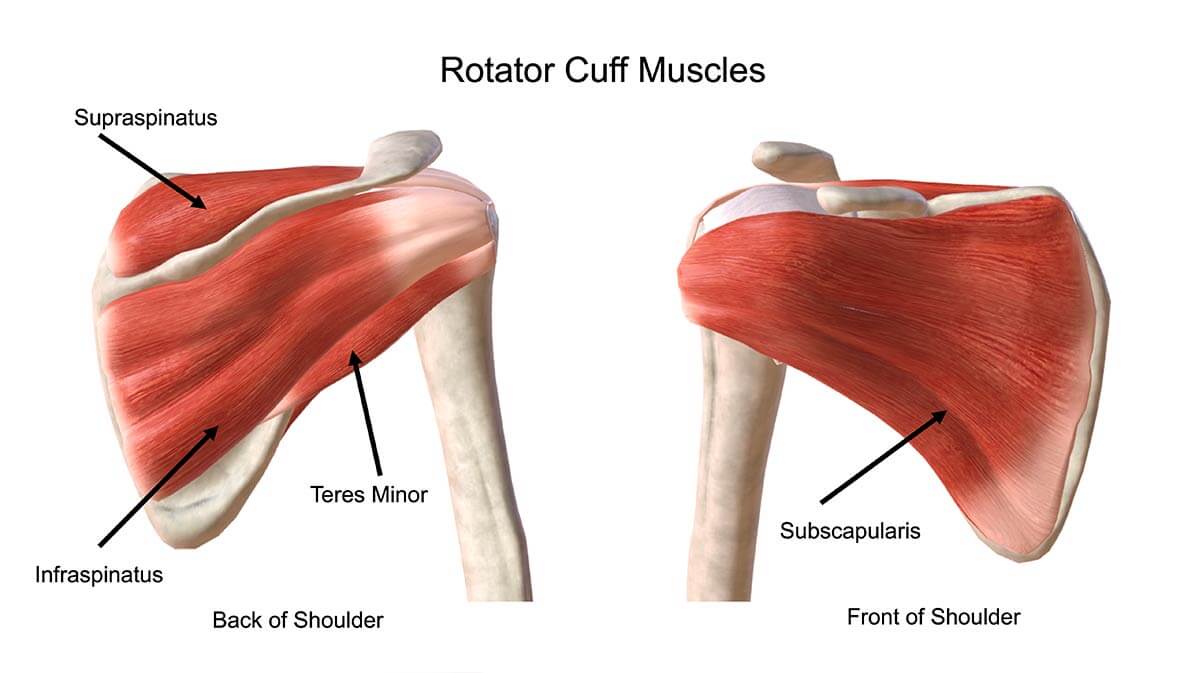
When a tear occurs in the cuff, it can involve one, or potentially all, of the rotator cuff tendons.
We grade rotator cuff tears according to the number of tendons torn and the degree of tearing of the tendon.
Partial tears don’t extend the full depth through the tendon, unlike full-thickness tears, which create a top-to-bottom hole through the tendon. Sometimes the tendon is torn all the way through and from side to side, and then it’s known as a complete rupture of the tendon.
The supraspinatus tendon is the most commonly torn rotator cuff tendon; if a complete rupture happens to all the four tendons, and if they detach by a distance of more than 5cm, this is known as a massive cuff tear.
What causes a rotator cuff tear?
For some people, it’s very obvious that a single event caused them a big pain in the shoulder – for instance if they picked up a very heavy object, or a fall caused them to severely jar the shoulder. When the rotator cuff is injured in this manner, we call it a traumatic tear.
Your experience might be different. It may be that your pain has gradually accrued over time after working in the garden or doing lots of sport. This slower brewing tear is known as a degenerative or chronic tear.

What are the symptoms of a rotator cuff tear?
If your tear is causing you symptoms, you might experience pain in your shoulder when you try to lie on that side at night. It may be generally achy through the day and it may be very difficult to move your shoulder into certain positions (e.g. lifting your arm above your head, or reaching your hand behind your back).
Losing strength is also a key symptom; this is important because your fine motor control activities, such as writing, rely greatly on a having a stable shoulder.
Washing or drying your hair can become very difficult. In extreme situations, you might even find it difficult to cut up your own food or eat.
Interestingly, many patients who are found to have a rotator cuff tear on imaging, have no symptoms at all. Additionally, it’s not always true that the more severe the tear, the more severe the symptoms.
As we age, so do our rotator cuff tendons, and that means we’re more susceptible to tears. Certain hormonal states, such as menopause, can also cause tendon weakening, but, age and menopause don’t necessarily mean we’ll have a painful shoulder. Only about half of the people who are over the age of sixty and have a cuff tear will have symptoms.
How is a rotator cuff tear diagnosed?
When you come to clinic, I’ll want to hear the story of your symptoms, how they came on, what kinds of activities are important to you, and what you’re finding difficult in terms of movement.
After closely examining you, I may recommend that we get an MRI or ultrasound scan to get a better understanding of the integrity of the cuff tendons and other shoulder structures.
What’s the treatment for a rotator cuff tear?
No two rotator cuff tears are the same, and no two people are the same. It very much depends upon your symptom history, factors such as your age, and how it’s affecting you.
The good news is, most rotator cuff tendon tears will settle well with good physiotherapy, sometimes with the addition of an ultrasound guided corticosteroid injection to help improve comfort levels.


Should I have surgery for my rotator cuff tear?
Occasionally, a torn rotator cuff may warrant surgery. If you’ve had trauma to the shoulder, suddenly had pain, and it’s a full-thickness tear, it may be advisable to have cuff tear repair surgery.
In the case of partial thickness tears, despite best attempts to settle a shoulder with physio and injection treatment, it might be necessary to opt for surgery if you have lots of pain or weakness.
Overtime, in much older patients, some tendon cuff tears lead to a condition called cuff arthropathy. The failing cuff leads to a wear-and-tear arthritis of the shoulder, and in some instances, it might be necessary to carry out a “reverse geometry” shoulder replacement.
What happens during rotator cuff surgery?
I perform rotator cuff repair surgery as a day case operation, which means you’ll typically go home at the end of the day, or if your surgery happens in the afternoon, you might have an overnight stay.
You’ll have a light general anaesthetic, and we’ll also carry out a nerve block, so that your shoulder is not painful when you wake up from surgery.
Usually, the repair of the cuff can be carried out through small incisions made around the shoulder (what’s known as arthroscopic or keyhole surgery), but if there is a very big tear, it may be necessary to make a bigger incision to get full access to the shoulder.
How is the tendon repaired?
The actual repair consists of stitching together the rotator cuff tendon tear with sutures, which are then anchored down to the bone on the head of the humerus with tiny anchors made from medical grade plastics or bioabsorble materials that become integrated with your own bone.
If it’s a partial thickness tear that’s being repaired, it may be possible to fix it with a special biological patch, called a Regeneten patch. This is a patch which is placed over the cuff tear through an arthroscopic surgical procedure, and fixed in place with little anchors.
The patch is made of collagen, and over the course of three months it induces a healing response from the tendon, so that it thickens and strengthens.
Are there any potential complications of rotator cuff surgery?
Thankfully, surgery usually goes as planned. Infection or injury to structures such as blood vessels or nerves is very rare, but occasionally stiffness or some continued pain may happen after the surgery. Sometimes the tendon can retear, this is due to the biological condition of the tendon and the bone. The good news is that complications can be treated.

How long does it take to recover from rotator cuff surgery?
When you leave hospital, your arm will be in a sling across your body to protect the surgical work. You’ll be given some initial exercises to carry out to help prevent stiffness which will later be progressed by your own physiotherapist. Most people can wean off using the sling at around a month, and most are back driving by six weeks.
You might expect to be able to carry out some gentle breaststroke swimming at around six weeks and getting back to front crawl swimming or golf at around three months.
By six months, you’ll really be reaping the rewards of your rehab efforts, but it can take up to a year for your shoulder to be at it’s very best after the surgery.
Post surgery FAQ
Ms Susan Alexander is a senior orthopaedic surgeon and is recognised by all the UK’s major insurers.